Forest Society of Maine

Your land trust for Maine's North Woods

Your land trust for Maine's North Woods.
.

  • Facebook
  • Instagram
  • LinkedIn
  • Home
  • About
    • Committed to Diversity
    • All About FSM
    • Mission
    • F.A.Q.’s
    • Meet our Staff
    • Directors and Advisors
    • Job Openings
    • Swan Internship
  • Conserved Lands
    • FSM Conserved Lands
    • Projects Under Way
    • Caring for Conserved Lands
    • Statement of Conservation Position
  • Forests & Climate
    • FSM Conservation and Carbon Sequestration
    • Partnerships to Improve Fish Passage and Climate Resilience
    • Fighting for the Forests’ Future
    • Wood’s Role in Net Zero Carbon Buildings
    • Maine Won’t Wait
    • Forest Carbon Task Force
    • Maine’s Carbon Budget
  • Wabanaki Engagement
    • FSM’s Wabanaki Engagement
    • Organizational Growth
    • Learning / Participation
    • How FSM is Taking Action
    • Resources & More
  • News
    • FSM News & Press
    • Signup for our E-Newsletter
  • Support FSM
    • Ways To Give
    • Financial Statement
    • FSM’s Supporters
  • Accessibility
    • Recite Me Software Info & Guide
  • Contact

People Support FSM in Many Ways

June 5, 2019 By FSM

FSM is fortunate to have friends that have made an annual gift for decades in support of our ongoing work. And many of these same folks, along with others, make special gifts on occasion—either in support of a specific project or in memory of a friend. These gifts are being made via check, credit card, stock, or retirement distributions.

A few of these same people informed us that FSM has been included in their estate plans. (Just in the past two years FSM has benefited from planned gifts which are allowing us to launch a summer internship program and other special projects). Some people choose a bequest; other people name FSM as a beneficiary of life insurance or a gift annuity. Each wants to leave a legacy in support of work they believe in. The Forest Society of Maine recognizes them as members of the Attean Circle, so named because the Attean lands were the foundation for FSM’s beginnings and now Attean Circle members are fortifying that base for the future.

A young outdoorsman hiking in Maine’s western mountains.

Each person has their own reasons for valuing FSM’s work and for continuing support for that work after they pass. Whether you believe in conserving Maine forests for economic activity, cultural values, recreation, their wild character, or something else, have you considered leaving a legacy that will benefit future generations beyond your lifetime? If you are interested in including (or have already included) FSM in your estate plans, speak with your attorney and then let us know so that we can recognize your enduring commitment.

Filed Under: Uncategorized

Forest conservation contributes to Moosehead region’s progress

May 30, 2019 By FSM

As printed in the Portland Press Herald, Letters to the Editor
May 25, 2019

Last week volunteers helped clear the treadway for a new trail north of Greenville, a family-friendly hike to the shore of Prong Pond, with views along the way of Big Moose Mountain. It’s just one of many new and improved trails that the state of Maine and partners have completed in the area since 2012, when the Moosehead Lake region conservation easement was made permanent, growing public opportunities for hiking, biking, camping, boating and more.

Other changes are afoot. In 2013, the Moosehead Lake Region Economic Development Corp. was founded, a group dedicated to growing and attracting new residents, local jobs and businesses. The Moosehead Lake Region EDC has commissioned economic development and branding studies that are now being implemented. They installed new, consistent signage to direct visitors to landmarks and businesses, and negotiated the purchase of lakefront lands, downtown, for a combination of open space and development.

East of the lake, Appalachian Mountain Club has invested millions in beautiful, modern lodges and the largest network of cross-country skiing trails in the Northeast. Just a short drive south, in Monson, the Libra Foundation has virtually transformed the downtown, rehabbing old buildings into galleries and workshop space for artists. Funded residencies give writers, painters, sculptors and others the chance to fall in love with our state’s rugged, authentic highlands.

Conserved forests are an essential part of these initiatives. Forests give us so much: Good jobs. Great communities. A glimpse into the past. A place for fish and wildlife to thrive. The chance to explore. As a land trust for Maine’s North Woods, the Forest Society of Maine is committed to sustaining these values.

As Maine moves forward, let’s remember the Moosehead Lake region and its progress. At the edge of Maine’s largest lake, land conservation has laid the framework for a better future.

Karin Tilberg

Executive Director, Forest Society of Maine
Bangor


Filed Under: Blog, News

Vernal Pools – A Sign of Spring!

May 23, 2019 By FSM

-by Kristin Peet, FSM Forestland Conservation Specialist

Yellow-spotted salamander. Photo by Pamela Wells

One of my favorite spring activities is to head out after dark on a warm, rainy night in April, flashlight and camera in tow, to look for frogs and salamanders heading to vernal pools to breed. I consider it a success if I see a spotted salamander (Ambystoma maculatum)–my all-time favorite!

Vernal pools are defined as “seasonal, semi-permanent or permanent bodies of water that are essential breeding habitat for certain amphibians and invertebrates and do not support fish” (Hunter, Calhoun, & McCollough, 1999). Vernal pools generally hold water for several months in the spring and early summer and are often dry by fall. They are essential habitats because several of Maine’s amphibian species breed in them almost exclusively, including the wood frog, spotted salamander, and blue-spotted salamander. Fairy shrimp are also considered an indicator species as they breed only in these vernal pools.

Forest managers and land stewards have the vital role of being the first in line to protect these sensitive habitats, which can be easily overlooked in other seasons. Maintaining canopy cover and shade is an important component of the habitat structure of vernal pools. You can find more information on how to manage vernal pools and other conservation resources at www.maineaudubon.org/resources.

This article was originally published in the Spring 2019 edition of Forest View, FSM’s biannual newsletter.

Filed Under: Blog, Uncategorized

Prong Pond Trail: from Flagging to (Almost!) Finished

May 23, 2019 By Erica

By Erica Cassidy Dubois
May 22, 2019

Last Saturday my husband and I woke up early to load our packs and our trusty trail dog, Arwen, into our 4-runner and head north. Outside of Greenville we met up with other volunteers from Moosehead Trails and state Bureau of Parks & Lands staff to put near-finishing touches on the new Prong Pond Trail.

The trip was exciting for me because, as a forestland steward for the Forest Society of Maine, I walked the “draft” route to Prong Pond years ago, back when it was just an idea and a trail of pink flagging hung in the branches of trees. Last summer, a professional Maine Conservation Corps crew roughed out the corridor and on Saturday volunteers cleared back winter debris and helped smooth out the footbed. It’s amazing the difference that a couple of leaf blowers, loppers, grubbing tools, and a half-dozen volunteers can make in less than a day!

The trail, once completed, will be just under one mile in length and run from the Prong Pond Road to the pond’s northeast shore. It’s a moderate hike, by Maine standards—no climbing over granite boulders, required—but it has enough elevation gain to reward hikers with an unexpected but outstanding view of Burnt Jacket, Big Moose, and Little Moose Mountains. It passes through a pleasant and relatively open forest of mature hemlock, yellow birch, and beech. The beech—like most in Maine—are suffering from the incurable and fatal Beech Bark Disease. Still, when the sun strikes last-year’s leaves, the whole golden understory glows. Sprinkled with interesting, glacial erratic boulders, the path to Prong Pond is going to be an especially great place for families to let nature-loving kids run wild and explore.

Construction of the trail came about as part of a years-long process to build or improve several non-motorized trails on the 359,000-acre Moosehead Region Conservation Easement (MRCE). The Prong Pond Trail is located on Weyerhaeuser (private) land, which the MRCE permanently conserved in 2012. The corridor is overlaid with a trail and access easement that was transferred from Weyerhaeuser to the state’s Bureau of Parks and Lands. In short: it’s complicated. But here’s the important bit. Once all the ‘i’s are dotted and the ‘t’s crossed, Weyerhaeuser will transfer small parcels on either end of the trail corridor, to the state, to be managed as a trail head parking area and a shorefront campsite, respectively. That means that, by this time next year, we’ll be able to launch canoes and kayaks from the Prong Pond boat landing, paddle over to the campsite area, and hike up the trail to the viewpoint.

Pretty sweet.

A note on wildlife: deer browse—where trees and other vegetation have been chomped back by hungry ungulates—is heavy through the trail corridor as it is located quite near to a Maine Inland Fisheries & Wildlife designated Deer Wintering Area. To minimize stress and impact on wildlife, BPL will promote the Prong Pond Trail as a three-season hike, and not a snowshoeing destination. Thanks for respecting wildlife and the good work of our state wildlife managers and biologists!View from from lookout of nearly completed Prong Pond Trail in the Moosehead Lake region.

Arwen, for her part, had a wonderful time sniffing deer trails, accepting kind words and pats from fellow volunteers, and at one point even helping to chew off a stubborn root I was attempting to clip out of the trail bed. (We’re lucky that Arwen, who has herding DNA, is more intent on keeping her pack of humans together than chasing after wildlife, otherwise Prong Pond might not be the best trail for her.) She spent the day running up and down a freshly-blazed trail, and slept a deep, satisfied sleep on the way home.


Erica Cassidy Dubois grew up in Dover-Foxcroft and works as forestland steward for the Forest Society of Maine.


Filed Under: Blog, News Tagged With: Moosehead Region

Timber Frame Buildings Span the Past and the Future

April 24, 2019 By FSM

For this article Anna Mercier spoke with Erin Connolly, owner of Connolly & Co. Timber Frame Homes and the Maine Barn Company, a longtime FSM business supporter.

Have you ever wandered through a timber frame home or barn, the timbers stretching gracefully upward like tree trunks, the exposed wood arching like branches far above your head? These structures are part of the New England landscape in a region where wood is a popular building material and several Maine businesses cater solely to their construction. One of the first to be established was Connolly & Company Timber Frame Homes & Barns.

Erin as a young girl with her father, John, inspecting a job up-close. Photo courtesy of Erin Connolly.

In the 1970s John Connolly, fascinated by the elegance of old joinery found in Maine’s barns, started a business building new timber frames. It was a new market back then, but over the years he has trained countless other timber framers in Maine—previous employees that have gone out on their own.

Generally, Connolly & Co. builds in New England and the East Coast but they have put up structures as far away as Colorado, Texas, and New Brunswick, Canada. They rely on Maine’s forests for Eastern white pine and hemlock, and much of their dimensional lumber comes from western Maine suppliers.

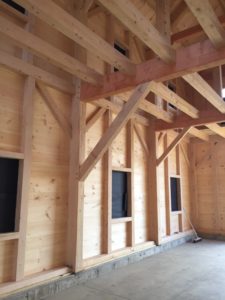
The inside of a timber frame building under construction. Photo by Erin Connolly.

Today John is retired and his daughter, Erin, who says she has been balancing on timbers since she could walk, is the owner. She has been working in the business for a little more than a decade and bought it four years ago. Under her leadership the business is quickly approaching the milestone of 300 frames built. It helps that they have a lot of repeat business from happy customers, and whose word-of-mouth referrals result in orders from friends or relatives. “I love the atmosphere,” Erin says, “the design aspect and the constant difference—some people come with a complete set of architectural drawings, others just have an idea in their head.” Before officially taking over in 2015, she spent about six years working both with her father who ran the business, and the framers down in the shop. One of her favorite always-evolving skills has been learning to design buildings and use Auto CAD (computer-aided design) software as well as SketchUp. She now does most of the designing herself and gets joinery help from her foreman who learned timber framing from her father.

Maine’s timber frame structures have spanned generations and this company, under Erin’s guidance, is doing the same. Perhaps decades from now future generations will be admiring some of these handsome, sturdy structures as much as they admire the people and forests that made them possible.

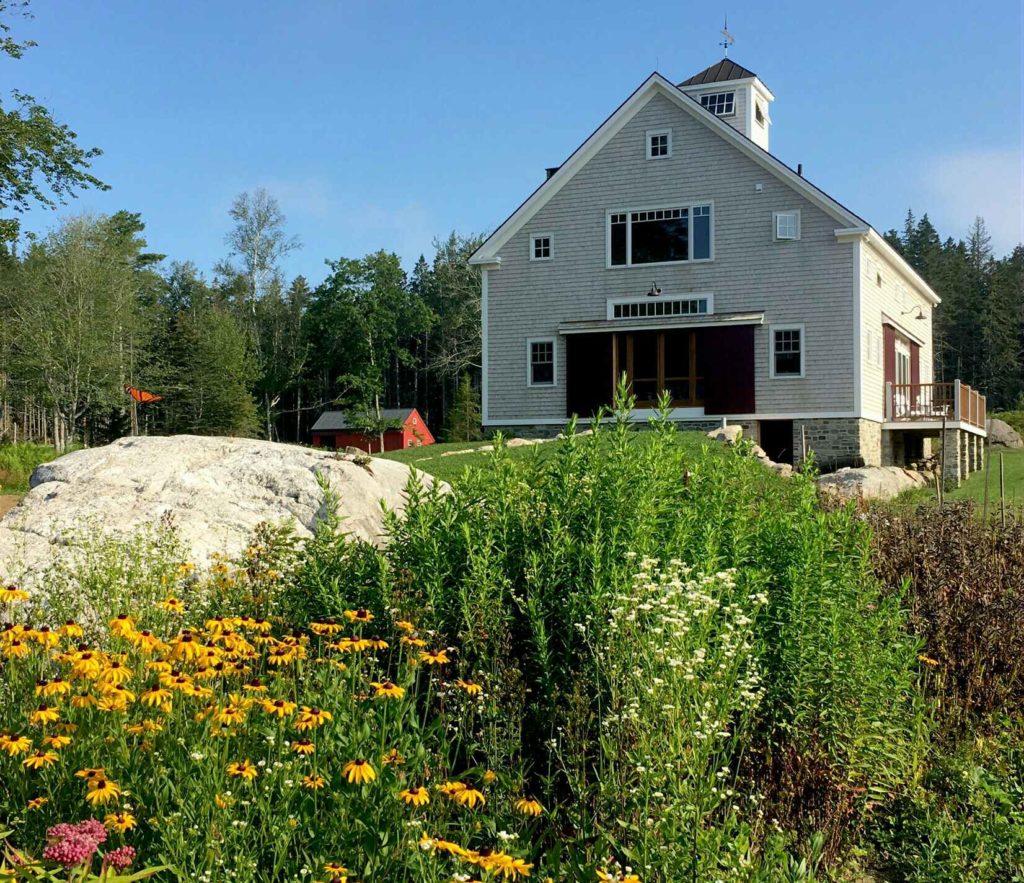
A completed timber frame building located on a Maine island. Photo by Erin Connolly.

Filed Under: Uncategorized

  • « Previous Page
  • 1
  • …
  • 13
  • 14
  • 15
  • 16
  • 17
  • …
  • 23
  • Next Page »

Stetson Mountain Fund Celebration

In 2009, the Stetson Mountain Fund was established at FSM with funding from First Wind. This fund provides … [Read More...]

Celebrating our Accreditation

We’re celebrating 17 years of being an accredited land trust! After a rigorous verification process by the … [Read More...]

Blog Posts

  • Stetson Mountain Fund Celebration
  • Welcoming our 2026 Swan Intern, Kaela Redman!
  • Get FSM’s Spring Newsletter

Conserved Lands

  • Alder Stream
  • Amazon – Musquash
  • Amherst Mountains Community Forest (AMCF)
  • Attean Pond
  • Bald Ledge, Bickford Hill, and Bickford Pond
  • Big Spencer Mountain
  • Boundary Headwaters
  • Branch Lake
  • Caribou Bog
  • Chandler Hill
  • Coburn Gore
  • Corner Pond
  • Debsconeag Lakes
  • Eagle Lake
  • Fish River Chain of Lakes
  • Fourth Machias Lake
  • Grafton Forest
  • Greenwood Ponds
  • Gulf Hagas – Whitecap
  • Haynes Brook
  • Hopkins Pond
  • Kennebago Forest
  • Little Big Wood Pond
  • Mattawamkeag River
  • Monson Pond
  • Moosehead Lake Shoreline
  • Moosehead Region
  • Moose River
  • Nicatous Lake
  • Nickerson Tree Farm
  • No. 5 and No. 6 Mountains
  • Reed Forest
  • Scammon Ridge Headwaters
  • Silver Lake – Pleasant River
  • Skitacook Lake
  • Sysladobsis Forest
  • Tearmunn Hardwoods
  • Timberdoodle Hill
  • Violette Brook Reservoir
  • West Branch of the Penobscot River
  • York Hill

Forest Society of Maine

209 State St, 2nd Floor
Bangor, Maine 04401
(207) 945-9200
info@fsmaine.org


PRIVACY POLICY

Sign up for FSM's E-News

  • Email
  • Facebook
  • Instagram
  • LinkedIn

Copyright © 2026 Forest Society of Maine · All Rights Reserved

Built with RainStorm Foundations & WordPress