Forest Society of Maine

Your land trust for Maine's North Woods

Your land trust for Maine's North Woods.
.

  • Facebook
  • Instagram
  • LinkedIn
  • Home
  • About
    • Committed to Diversity
    • All About FSM
    • Mission
    • F.A.Q.’s
    • Meet our Staff
    • Directors and Advisors
    • Job Openings
    • Swan Internship
  • Conserved Lands
    • FSM Conserved Lands
    • Projects Under Way
    • Caring for Conserved Lands
    • Statement of Conservation Position
  • Forests & Climate
    • FSM Conservation and Carbon Sequestration
    • Partnerships to Improve Fish Passage and Climate Resilience
    • Fighting for the Forests’ Future
    • Wood’s Role in Net Zero Carbon Buildings
    • Maine Won’t Wait
    • Forest Carbon Task Force
    • Maine’s Carbon Budget
  • Wabanaki Engagement
    • FSM’s Wabanaki Engagement
    • Organizational Growth
    • Learning / Participation
    • How FSM is Taking Action
    • Resources & More
  • News
    • FSM News & Press
    • Signup for our E-Newsletter
  • Support FSM
    • Ways To Give
    • Financial Statement
    • FSM’s Supporters
  • Accessibility
    • Recite Me Software Info & Guide
  • Contact

Greenville Memories: Cutting Ice

April 9, 2019 By FSM

One of FSM’s friends spent much of her childhood in Greenville, Maine as a young girl in the 1940s. Our friend was kind enough to share some stories with us. Here is an excerpt from a letter she wrote about a winter trip to Moosehead Lake. The first part of the trip was featured in the spring 2018 newsletter. If you missed it read the first part here.

Dear Mary,

Earlier I told you of our ride to Lily Bay in the mail truck with food for the logging camp and spilling eggs in the snow. Here is the rest of the story. We spent the night at a nice camp on the shore of Lily Bay on Moosehead Lake. We were glad to stay inside and play games after exploring everything in the camp. That next day was bitterly cold but the sun was bright. We had been told that there was to be ice cutting in the bay after breakfast. We didn’t want to miss out on that! The ice would be shipped to New York City by train later that day. We looked out the window and could already see the sleigh, horses, and men. I had been given new skates for Christmas—figure skating skates. I could hardly wait to use them! I had seen others skating and knew I could do it, too! We bundled up in our heavy woolen pants and jackets and walked on the snow-covered ice to the sleigh to sit as the men laced our skates.

The ice where they were cutting in the windy bay was crystal clear, the snow having been blown away, and we could see fish swimming below the ice. I had never seen it like that as usually it freezes in bumpy waves. The men cut the ice using very long saws with a handle at one end. They would use an ax to chop a place to begin using the saw for the first block of ice which was three feet thick and cut a straight line towards them for three feet. Then they began another cut at a right angle for the second side for three feet, turned at a right angle to cut three more feet, and turned again to meet the first cut. There was a 3×3 foot ice block floating. After making several cuts like this there was a line of 3×3 foot cubes, and they began loading the cubes onto the sleigh. How did they do this?

The men used tongs to pull the blocks onto safe ice, being careful not to slide into the open water. Ice tongs are like most tongs but have very sharp long points to grasp the slippery blocks. It was piled onto the sleigh. The horses would pull the sleigh all the long, cold, windy way down the lake to the train station while the driver sat bundled up in buffalo robes to stay warm. There the ice would be moved into boxcars with sawdust packed all around each block to keep it from melting on its trip to New York, Boston, or some other distant place. We had an ice house at home so I knew all about this—I just wanted to skate!

Confidently I pushed off with the toe of my skate and smooth as could be landed hard, face first, nose-down on that cold, hard ice! It hurt and I was stunned. My nose was bleeding and I was crying and the ice was blood red. Someone helped me up and told me I had broken my nose. Their sympathy made me cry—and bleed—harder. My injured nose would not sell well in the city, so my face had to be washed clean, and my friends returned to camp with me. They made sure I held chunks of ice in my mitten to keep me from swelling and turning black and blue. I lay down, wanting to rest and cry, but they told me I had to sit up and keep my head up. I had been told to keep using the ice and no one would let me sleep. Later I was given something for the pain so I could sleep and I was taken home the next morning. I was black and blue for weeks and it hurt to laugh.

It is a trip I clearly remember, mostly with pleasure and good memories, but I learned not to try to be a showoff, too. One lesson like that was enough!


This story first appeared in the spring edition of Forest View, FSM’s biannual newsletter. 
Filed Under: Blog

Granite peaks and golden eagles:

March 27, 2019 By Erica

Maine’s northern forests are important to the biodiversity of the world

by Erica Kaufmann, Forestland Steward

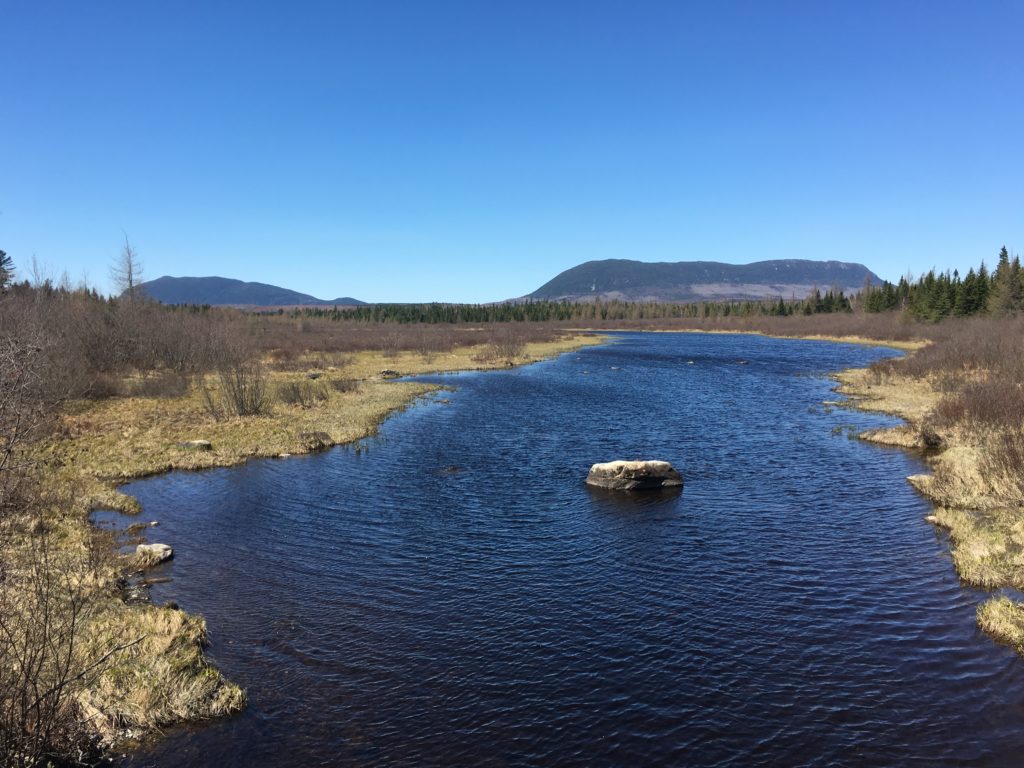
Big Spencer over Lazy Tom Bog
Big Spencer Mountain over Lazy Tom Bog

The first summer I worked as a Forest Society of Maine (FSM) steward, I took a monitoring trip up Big Spencer Mountain. It was early July; the weather was sticky and hot, and my colleague and I spent the day picking our way over rocks, ladders, and the half-brittle tree crowns that fierce winter winds had broken off and scattered along the trail.

It was mid-afternoon and we were headed home, bouncing down the Sias Hill Road when it happened:  a massive bird swooped low and crossed the road about 30 feet in front of our truck. The huge raptor hung in the air and snatched at some small animal rustling in the grass. It missed. Then it changed direction, fast, long brown flight feathers slipping through air like fingers moving through water. As it sailed off, we twisted our necks to gape back through the cloud of dust, blinking and trying to get a last look.

I’d heard people claim, before, that they’d seen a golden eagle and always assumed that they’d misidentified a juvenile Bald. But the bird I saw that day was far bigger than any adolescent bald eagle I’d ever seen, so I consulted an ornithological expert:  my boss at the time, the late Alan Hutchinson, who spent many years working with raptors. Alan assured me that it is not uncommon for golden eagles to use Maine’s remote mountains as hunting grounds.

I was recently reminded of my avian encounter while reading a 2016 paper by Janet McMahon, M.S., Diversity, Continuity, and Resilience—The Ecological Values of the Western Maine Mountains. McMahon’s paper catalogs a number of ways in which the habitats of northern and western Maine are significant on a continental and even global level.

McMahon defines the Western Maine Mountains as the “broad band from the summits of the Katahdin group… to Boundary Bald Mountain and the Mahoosuc Range on Maine’s western border,” an area that encompasses more than 5,000,000 acres. In addition to being “the only region in the eastern United States with year round activity by golden eagles, Maine’s rarest breeding bird,” the Western Maine Mountains are home to all of the state’s tallest mountains; tundra and boreal communities that occur in few places around the world, and 139 species of rare plants and animals.

Diversity, Continuity, and Resilience does an excellent job highlighting how “the timber value and resilience of [the region’s] vast forests, most of which have been in private ownership and actively managed for more than two centuries,” have been key to retaining large blocks of undeveloped, road-less land—“…the only place,” McMahon writes, “in the eastern United States where such a large area has remained continuously forested since pre-settlement times.”

Moosehead Lake, of course, is at the heart of these ecologically rich forestlands. As we take stock of the region’s many assets, we can celebrate being at the core of what the National Audubon Society has identified as our country’s largest globally important area for birds. We can boast that the woods around Nahmakanta Lake contain “the highest concentration of pristine, remote ponds in New England.”

McMahon’s paper, which includes many more facts and superlatives than I can echo in this article, is available for download at ‘mainemountaincollaborative.org/resources/.’ It’s an accessible read about some of the many gifts that Maine’s vast forests give to us residents, our visitors, and to the world.

The Forest Society of Maine is a non-profit land trust that has helped to conserve more than 1,000,000 acres of Maine’s North Woods for their ecological, economic, recreational, and cultural values. Learn more at fsmaine.org.

Originally published in Moosehead Matters, March 20, 2019


Filed Under: Blog

George Browning, active FSM advisory council member, passes away

January 8, 2019 By FSM

It is with great sadness that the Forest Society of Maine (FSM) announces the passing of FSM advisory council member George W. Browning.


George served on FSM’s board for many years before joining the advisory council. During this time, he actively promoted numerous conservation projects and helped expand FSM’s network of supporters. In addition to his role on the advisory council, he remained part of the FSM finance committee and investment subcommittee. George loved fishing and cared deeply for the forests, rivers, ponds, and mountains in the North Woods. He will be greatly missed by many at FSM.

Obituary for George W. Browning


Photo courtesy of Alix Hopkins.

Filed Under: Blog

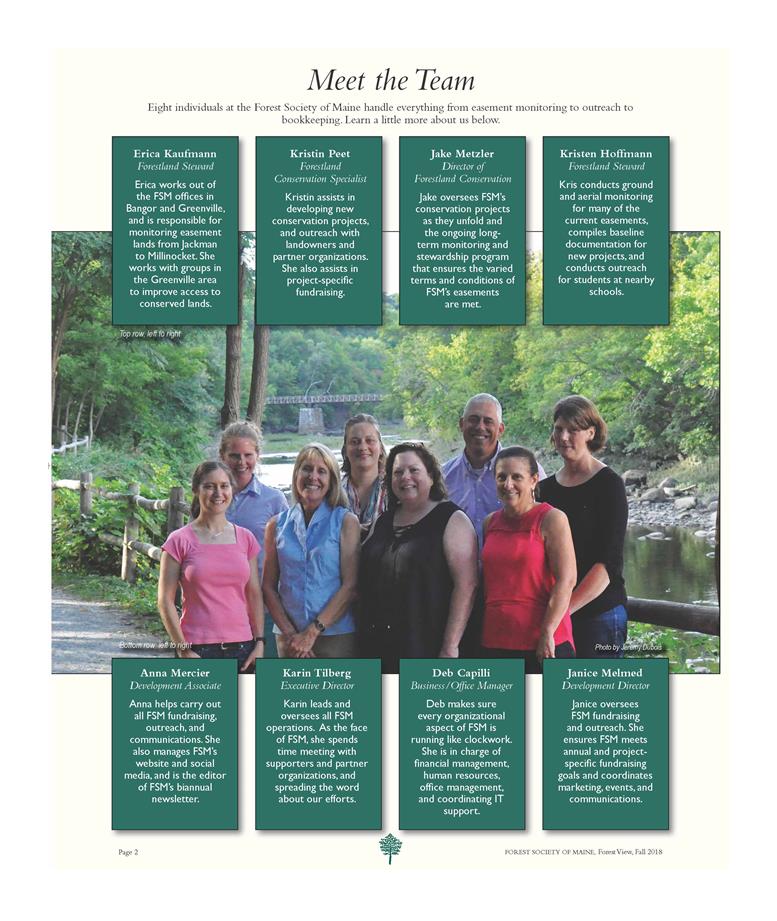
Meet the Team

December 10, 2018 By FSM

Top row, left to right:

Erica Kaufmann, Forestland Steward. Erica works out of the FSM offices in Bangor and Greenville, and is responsible for monitoring easement lands from Jackman to Millinocket. She works with groups in the Greenville area to improve access to conserved lands.

Kristin Peet, Forestland Conservation Specialist. Kristin assists in developing new conservation projects, and outreach with landowners and partner organizations. She also assists in project-specific fundraising.

Jake Metzler, Director of Forestland Conservation. Jake oversees FSM’s conservation projects as they unfold and the ongoing longterm monitoring and stewardship program that ensures the varied terms and conditions of FSM’s easements are met.

Kristen Hoffmann, Forestland Steward. Kris conducts ground and aerial monitoring for many of the current easements, compiles baseline documentation for new projects, and conducts outreach for students at nearby schools.

Bottom row, left to right:

Anna Mercier, Development Associate. Anna helps carry out all FSM fundraising, outreach, and communications. She also manages FSM’s website and social media, and is the editor of FSM’s biannual newsletter.

Karin Tilberg, Executive Director. Karin leads and oversees all FSM operations. As the face of FSM, she spends time meeting with supporters and partner organizations, and spreading the word about our efforts.

Deb Capilli, Business/Office Manager. Deb makes sure every organizational aspect of FSM is running like clockwork. She is in charge of financial management, human resources, office management, and coordinating IT support.

Janice Melmed, Development Director. Janice oversees FSM fundraising and outreach. She ensures FSM meets annual and project specific fundraising goals and coordinates marketing, events, and communications.

Read more about our staff’s background.

Filed Under: Blog

Local Tree Farm Donated to Forest Society of Maine

July 27, 2018 By Erica

Nickerson Tree Farm


The Forest Society of Maine (FSM) recently accepted the generous gift of approximately 80 acres of forestland located along Rt. 15 in Greenville.

The Nickerson Tree Farm property was donated to FSM by Ellen Poole in July. Ellen is the daughter of the late Dr. Norman Nickerson, who started his decades-long career as a physician in the Moosehead Lake region in 1920. For many years, Ellen has kindly invited the public to enjoy her property via walking and skiing trails that loop through the woodlot. Under the terms of her gift, FSM anticipates assessing the existing trail network, working to maintain the trails, and exploring new ways to provide outdoor recreation and environmental education opportunities for students and adults living in and visiting the Moosehead Lake region.

“I trust the Forest Society of Maine,” Mrs. Poole stated at the time of the donation, “that’s why I’m giving my land to them.” She added, “I know they will be good caretakers.”

“In addition to being a fantastic place for families to walk and ski, Nickerson Tree Farm has an amazing location as part of the Rt. 15 gateway to Moosehead Lake,” said FSM Executive Director Karin Tilberg. “We’re honored and humbled to be a part of Ellen’s legacy, and we’re excited to work with the community to fulfill her vision for the long-term care and stewardship of the property.”

Nickerson Tree Farm is adjacent to the Moosehead Lake Region Visitors’ Center where FSM currently maintains an office.

Individuals or groups interested in learning more about the Nickerson Tree Farm are encouraged to contact FSM at 207-945-9200.

Filed Under: Blog, News Tagged With: Moosehead Region, Nickerson Tree Farm

  • « Previous Page
  • 1
  • …
  • 7
  • 8
  • 9
  • 10
  • 11
  • …
  • 15
  • Next Page »

What’s in it for you? Discover Your Nearby Land Trusts

January 22, 2026 6 -7 PM Bangor Public Library Norman Minsky Lecture Hall Join​ us for a panel featuring … [Read More...]

Blog Posts

  • What’s in it for you? Discover Your Nearby Land Trusts
  • 2026 Swan Internship Applications Open

Forest Society of Maine

209 State St, 2nd Floor
Bangor, Maine 04401
(207) 945-9200
info@fsmaine.org


PRIVACY POLICY

Sign up for FSM's E-News

  • Email
  • Facebook
  • Instagram
  • LinkedIn

Copyright © 2026 Forest Society of Maine · All Rights Reserved

Built with RainStorm Foundations & WordPress